
Expanding on Max Stirner: The Limits of Ego
A Critique-Like Expansion on Stirner's Concept of the Spook

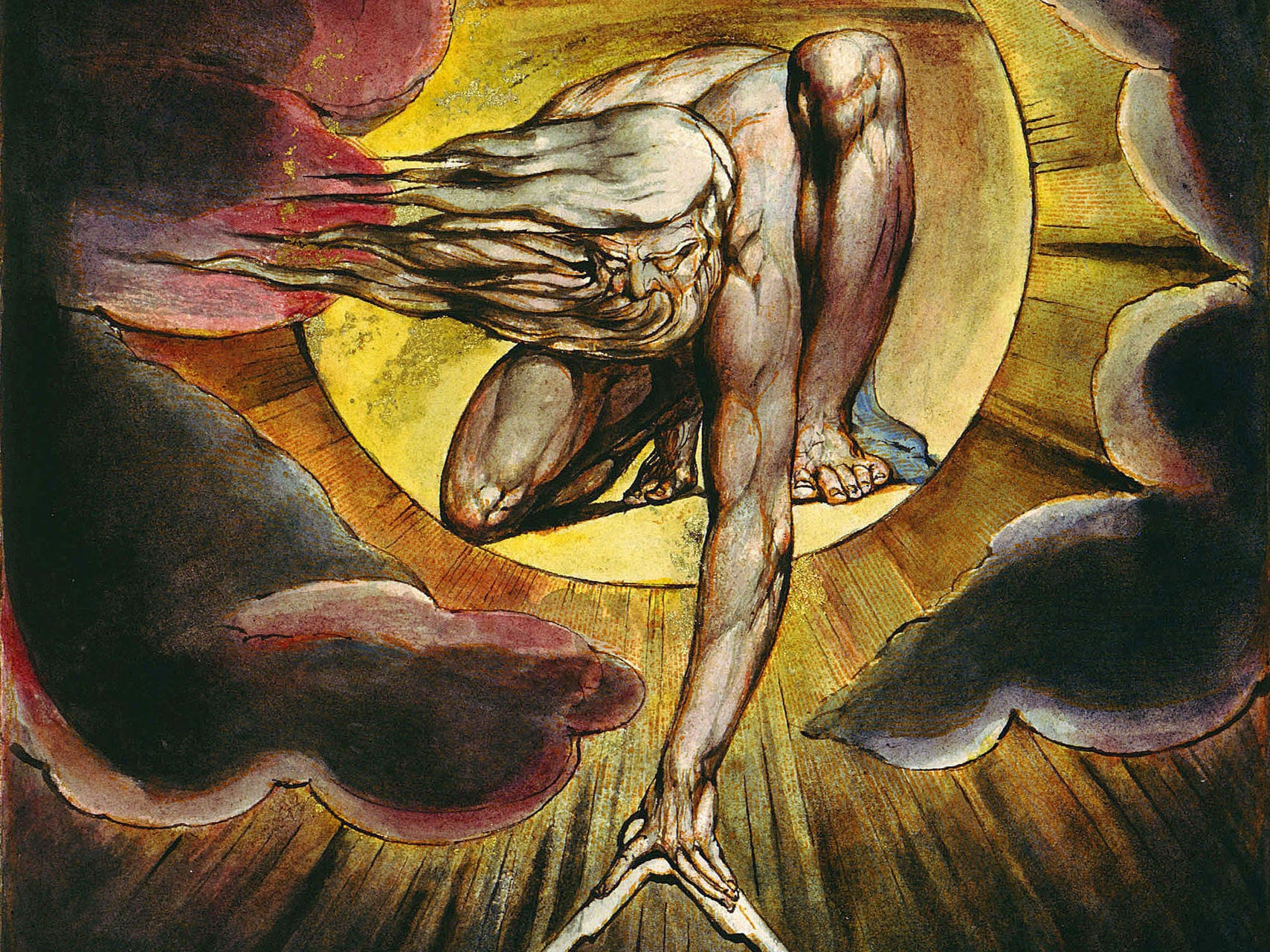
The Ancient of Days - William BlakeAbstract
Shortly after writing Freedom & Its Illusion Quantified, I began searching for similar ideas in philosophy and came across Max Stirner. While this article may read like a critique, from Stirner’s perspective, I can only point out that his desire to protect the ego is incomplete and overlooks the physical realities that interact with it. This article also introduces the concept of the physical spook, something Stirner seems to dismiss.
If at any point the reader believes I’ve misunderstood Stirner or noticed any flaws in my reasoning, feel free to respond. If I find their critique valid, I will update this post accordingly.
Reader’s Notes
Stirner meant ‘the Unique One’, not pure ‘ego’ - that distinction is valid, but my article remains in-tact. Read this way, he likely stands closer to Nishida. Even so, the questions raised here remain. Whatever he treats as ground exerts influence simply by being made conscious. His ‘ego’ may not desire, but his ‘being’ still does.
Brief Summary of Stirner
Below is a summary of Max Stirner's core ideas, not direct quotes from his work:
The Ego (The Unique One): The self, defined by individual will and desire, free from external authorities or ideals.
The Spook: An external idea or ideal (e.g., morality, religion, the state) that has power over the individual by being perceived as a higher truth. Once you recognize it as a spook, it no longer controls you, as you see it for what it is, just an idea, not an objective authority.
Union of Egoists: A temporary, self-interested alliance where individuals come together based on mutual benefit, not shared values or obligations.
Why I technically Can’t Criticize Stirner
When people hear the term ‘ego’ or encounter someone advocating for egoistic actions, they immediately associate it with selfishness and its negative connotations. However, given that we are all thinking beings interacting with our senses, it’s only natural that we each aim to order and shape our own world. This doesn’t necessarily mean that altruism, love, or reciprocity are absent; it simply means that when I take an action that feeds my drive, I do it because it benefits me in some way. With that in mind, I’d like to introduce a new distinction.
We are all egoists, but people’s actions generally fall into two categories. I emphasize the word generally because actions exist on a gradient, and it’s nearly impossible for any modern human action to fit perfectly into one of these categories. As Stirner would say, these labels are spooks in themselves.
Local Egoist: A Local Egoist acts solely in their own self-interest, with no drive to benefit others, whether consciously or unconsciously. They are focused on their personal gain in the moment and do not consider the broader impact on other egos. An example is a parasite only harming the ego of the host.
Extended Egoist: An Extended Egoist, while still acting for their own best interest, recognizes the interconnectedness of other egos (consciously or unconsciously). Their actions benefit other egos, either directly or indirectly, and their ego rewards them. An example is human love, I am drawn to someone who is also drawn to me.
Now that we’ve clarified these terms, the initial repulsion that many people feel toward Stirner’s philosophy can start to fade. The reason I can’t criticize Stirner’s core philosophy is that, at the end of the day, he can always fall back on his own ego. To him, everything outside his ego is a spook, including the advocacy for detecting spooks itself. Stirner could easily argue that anything he does is merely him influencing other egos in accordance with his personal philosophy. Essentially, he’s stating, “This is my philosophy for my life, do with that what you will”.
I can approach his ideas using reason, but even that, from his perspective, is a spook imposed on his ego. So, all that’s left for me to argue is that his way of living, his approach to defending his ego, might actually go against his very goal of protecting it.
Asymmetries
Physical Spooks
Stirner seems to dismiss physical realities and their effects on the ego. In doing so, he overlooks how these realities can create the very effects of his spooks that he claims restrict the ego. For example, let’s consider the union of egoists. Imagine a society built on a contract, essentially, any modern social structure where the abstractions are honest, and everyone consents. In this society, one group controls all the resources the ego desires. As a result, the social contract no longer benefits Stirner’s ego, so he decides to break it and take the resources back. However, he’s not strong enough to act, as the group also controls force.
Now Stirner is hungry and must control his ego and thoughts. But if he can control his ego’s hunger, why would he have opted out of the contract in the first place? The physical has become mental. Stirner might wave this off as merely a question of power, but if he truly cares about his ego enough to strip down abstractions, he should also seek to strip away the physical realities that his ego is responding to. If Stirner wants to claim that the physical world is just power, then he should also claim that spooks are simply power. If he advocates using force to combat physical power, he should apply the same logic to spooks. If these two elements were symmetrical, rather than stripping away spooks, Stirner would advise people to use spooks against one another.
Mental Spook: Cannot be escaped, shapes behaviour, demands submission, and diminishes ego autonomy.
Physical Spook: Cannot be escaped (since you are alive), shapes behaviour, functionally demands submission, and diminishes ego autonomy.
Now, there's a problem. If you care about the autonomy of the ego over time, you must balance both the Mental Spook and the Physical Spook. This seems to be the very task of governance that Stirner often criticizes. In other words, the constant attempt to strip away spooks may not actually lead to egoistic autonomy. If you believe it does, then that belief itself becomes a spook. A purely free spirit, according to Stirner’s definition, would be nothing more than a purely instinctual animal, devoid of reason. However, for that kind of freedom to exist, at some point, spooks might be necessary to deal with the physical.
Put simply:
The ego tries to escape Spooks.
The ego uses reason to identify Spooks.
But reason itself constrains you, meaning you never truly escape confinement.
The Myth of Opting in and Opting Out
There is no true opting out as long as you are alive and a spook exists; there is only distance. Here’s an example:
My ego may choose to opt out of reason, but the egos around me, who still have access to me, decide not to. These surrounding egos use reason to control my ego, through means like surveillance, manipulation, etc. While my ego may think it’s free, it faces the same problem.
The only way your ego can be truly free over time is if the distance between you and external influences is far enough that they no longer impact you. Yet, the average human ego as it stands appears to crave companionship and procreation involving other egos. This also assumes there isn’t something we’re unaware of, like quantum entanglement, that connects the entire universe in a meaningful way locally.
Integrated Spooks
The idea of integrated spooks isn’t so much an argument against Stirner, but rather an attempt to move past the rebellious allure. Stirner claims that people are ‘possessed’ by spooks, but that’s not the whole picture. There may be ghosts all around us, but the ego itself is made up of ghosts, only, these ghosts have transformed into instinct.
Assuming Darwinism, consider this example: Let’s say in Japan there was a spook that claimed small faces were divine. As a result, people with smaller faces received better social treatment, which in turn helped them procreate. Since the spook takes time to process in the mind before being acted upon, the people who are naturally attracted to small faces would propagate faster, until a large portion of the population is attracted to small faces, even without the spook. The spook has integrated.
By following the ego, you’re not necessarily avoiding behaviours shaped by spooks. You’re simply responding to current social reinforcements. In fact, you’re even more susceptible to the spooks of your ancestors. Perhaps these ingrained behaviours serve you better because they’ve been tested by evolution, but that doesn’t make you any less influenced by other egos.
Stirner in One Sentence
Stripped down to what Stirner can consistently say under his own philosophy, it is this:
My ego taps into the abstraction known as reason to show other egos that abstractions can control you.
He cannot say anything beyond this without falling into the ‘opt-in, opt-out’ problem or creating a spook that contradicts his own ego. He also cannot speak for the ego as a whole, since the ego is always interacting with the physical world. Furthermore, he cannot claim that spooks are inherently bad, as this would be using morality, which, by his definition, is itself a spook.
Why Stirner is Still Useful
Freeing the Ego Mentally
Even when stripped to its core, Stirner still offers a useful tool for recognizing abstractions that control one’s desires. Let’s take Nihilism as an example. At its core, Nihilism asserts:
Life has no inherent meaning or value.
But to judge life meaningless already presupposes a sense of meaning or value. Recognizing meaninglessness does not create meaning by itself, but it reveals the standards by which we judge. Because consciousness is rooted in evolved instincts, our capacity for meaning-making is biologically grounded, even if the meanings we pursue go far beyond instinct. This is something Stirner would likely agree with. A nihilist might then argue:
The universe has no meaning; the universe is uncaring.
But we are not separate from the universe; we are the universe. If we have meaning, then the universe has meaning. The universe is not uncaring as long as we care. If you believe the universe has no care, you might simply be too distant from its care. If you want the universe to care, then care. The act of believing the universe has no care creates the exact universe you believe in.
Now, using Stirner’s concept of the mental spook, we can see how belief in Nihilism can harm the ego. A person who believes in Nihilism might be trapping themselves. Recognizing it as a spook could free the ego, allowing it to act in ways that serve its long-term desires.
The Spook Fallacy
Stirner is also valuable in challenging those who claim to be freeing the individual from one spook, only to replace it with another. For example, while there has been a recent surge in people embracing religion, many still criticize it while continuing to worship the dollar. They live in a constant state of hunger, chasing an abstraction they perceive as reality, yet they mock others for believing in a god. From Stirner's perspective, they are merely swapping one abstraction for another. Yes, money may be essential as a societal glue to prevent chaos, enabling societies to scale, but it’s still just another abstraction with trade-offs. One could argue that one spook might statistically allow the average ego to flourish more than another (if that can even be measured practically), but it’s misleading to claim that people are being entirely freed. The moment you call something freedom, people will chase it, yet it can never exist. Freedom is a concept of reason, yet reason must end in order to reach it. Freedom is a spook.
For a further dissection of Stirner, see my later post, The Nishidan Spook: Authority After the Ego.

If this work matters to you, your support is what allows it to continue