
The Nishidan Spook: Authority After the Ego
Max Striner: One Level Deeper

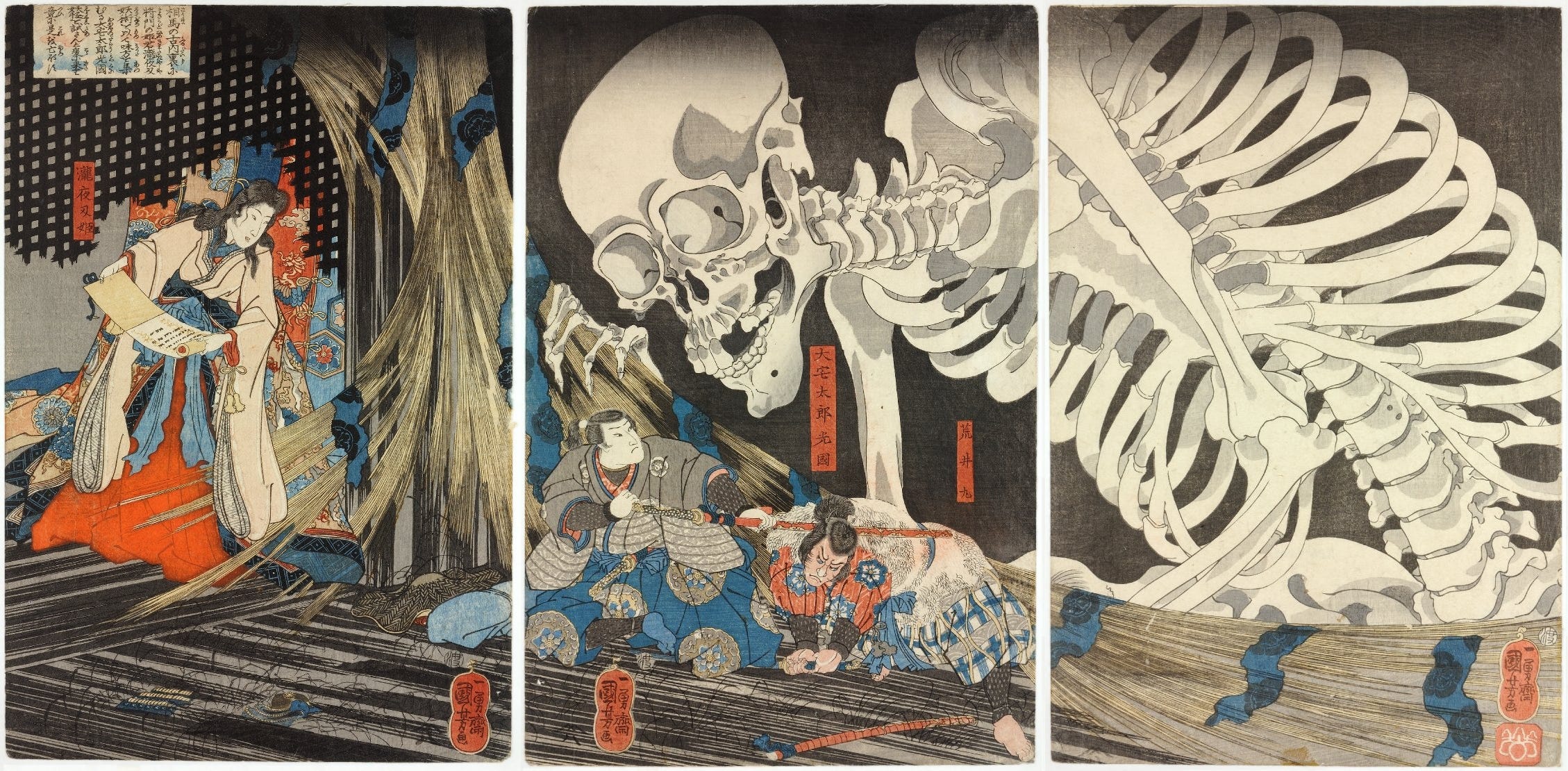
Triptych of Takiyasha the Witch and the Skeleton Spectre - Utagawa KuniyoshiAbstract
In this article, I revisit my earlier post Expanding on Max Stirner: The Limits of Ego. Through Kitarō Nishida, I argue that Stirner’s philosophy is ultimately incomplete. Building on my previous claim that full egoistic autonomy does not automatically entail full egoistic benefit, this article pushes The Spook one level deeper by examining Nishida’s analysis of what claims to be Being in totality. Here, I introduce the concept of the Nishidan Spook, a next-stage critique of Stirner that holds Stirner’s own ego-centered philosophy to be an illusion in itself.
Max Striner Revisited
Below is a summary of Max Stirner’s core ideas, not direct quotes from his work:
The Ego (The Unique One): The self, defined by individual will and desire, free from external authorities or ideals.
The Spook: An external idea or ideal (e.g., morality, religion, the state) that has power over the individual by being perceived as a higher truth. Once you recognize it as a spook, it no longer controls you, as you see it for what it is, just an idea, not an objective authority.
For a more detailed discussion of Stirner, please see my earlier post, Expanding on Max Stirner: The Limits of Ego.

Nishida Kitaro and ‘Being’
Nishida’s Argument
Experience is primary, before there is a subject who thinks or an object that is thought about, there is the occurring of experience itself. The ego arises within this field as a later differentiation, useful, real, and operative, but not foundational. What appears first is not an ‘I’ confronting a world, but an undivided field of experience in which seeing, hearing, acting, and feeling occur without ownership. Only afterward does reflection draw a boundary, identifying a center (‘self’), an object, and a relation between them. The individual does not first recognize a self and then perceive; rather, perception happens first, and the self is named after the fact as a way of organizing and stabilizing what has already appeared.
When the ego is treated as the center, a derivative distinction is mistaken for the ground, freezing a fluid process into a substance. This move subtly reorganizes reality around ownership and installs a hidden metaphysics even when all external authorities have been rejected. At a deeper level, being itself can be hijacked in the same way: any partial articulation, ego, subject, reason, history, even ‘being’ or ‘nothingness’, becomes illusory the moment it claims to be Being in totality. For Nishida, being appears and differentiates, but it cannot be finished, owned, or closed without distortion.
Stirner Possessed
As a result, Stirner operates within the very illusion he seeks to expose, controlled in the same manner he condemns, as I argued in my previous post. The ego comes to rule him as a form of ‘being’ itself. In following the ego, he remains bound to abstraction, to an abstracted notion of ‘being’.
Stirner runs into trouble once the ego becomes explicitly known and argued for as the center: by becoming aware of the ego and defending it, he treats it as something that should be followed, turning it into a ground. Even if he denies morality, this installs a hidden ‘ought’ and elevates the ego into an abstraction. By contrast, an implicit ego, acting, desiring, responding without being named or justified, still operates, but it is not worshipped. Nishida’s point is that ego-action is not the problem; ego-as-conscious center is.
Nishidan Spook
Nishidan Spook: Any abstraction that does not merely dominate thought (as in Stirner), but reorganizes experience itself by masquerading as the ground of being.
Stirner asks: What rules over me?
Nishida asks: What claims to be the ground at all?
Where the Stirnerian Spook seeks to preserve the ego, the Nishidan Spook seeks to preserve being itself.
Stirnerian Spook: Rejects the State, morality as obligation, God, Humanity, Truth as authority, law, duty, and any ideal or abstraction that claims authority over the individual and demands obedience; Stirner’s criterion is whether an idea rules the ego, and his demolition stops where self-ownership is affirmed.
Nishidan Spook: Rejects the ego as ground, the subject as origin, Being or Nothingness when reified, reason as ontology, history or progress as destiny, God as object or system, and any final metaphysical claim that pretends to totalize reality; Nishida’s criterion is whether a claim presents itself as reality itself rather than as a provisional appearance within it.
Absurdism as a Diagnostic Example
Let us turn to Albert Camus and the idea of the absurd. Camus describes the absurd as a lived tension between the human demand for meaning and the world’s silence. It is not a metaphysical truth about reality itself, but a condition of experience. His response is one of lucid revolt, to continue living, creating, and acting without appealing to false consolations or final answers. For Camus, this means confronting life’s absurdity directly and refusing to anesthetize it with hope, transcendence, or metaphysical meaning. The pain and tension are not problems to be solved but conditions to be endured consciously. By staying lucid and resisting escape, one transforms suffering into intensity, finding freedom and dignity in living fully despite, and alongside, the absurd.
Stirner, however, would immediately reject any rule or obligation derived from this diagnosis the moment it claims authority over the individual. For Stirner, absurdity, revolt, acceptance, or indifference are all legitimate only insofar as they serve the ego’s own interest; the instant they harden into a ‘must’, they become a Stirnerian Spook.
Nishida would press the critique even further. He would warn that absurdity itself becomes a Nishidan Spook when it is treated as a total account of reality or as a foundational principle for how one ought to live. The absurd is real as an appearance within experience, but it becomes illusory the moment it claims to be Being itself. If someone treats absurdity as Being itself, they turn a lived tension into a ruling ground, so life gets filtered through a fixed idea (“everything is absurd”) rather than met as it unfolds. Action becomes loyalty to an idea of absurdity instead of responsiveness to what is actually happening.
For a further dissection of Stirner and Nishida, see my later post, The Emonian Spook: The Illusion That Ends Illusion (Max Stirner: The Last Layer).

If this work matters to you, your support is what allows it to continue