
The Emonian Spook: The Illusion That Ends Illusion
Max Stirner: The Last Layer

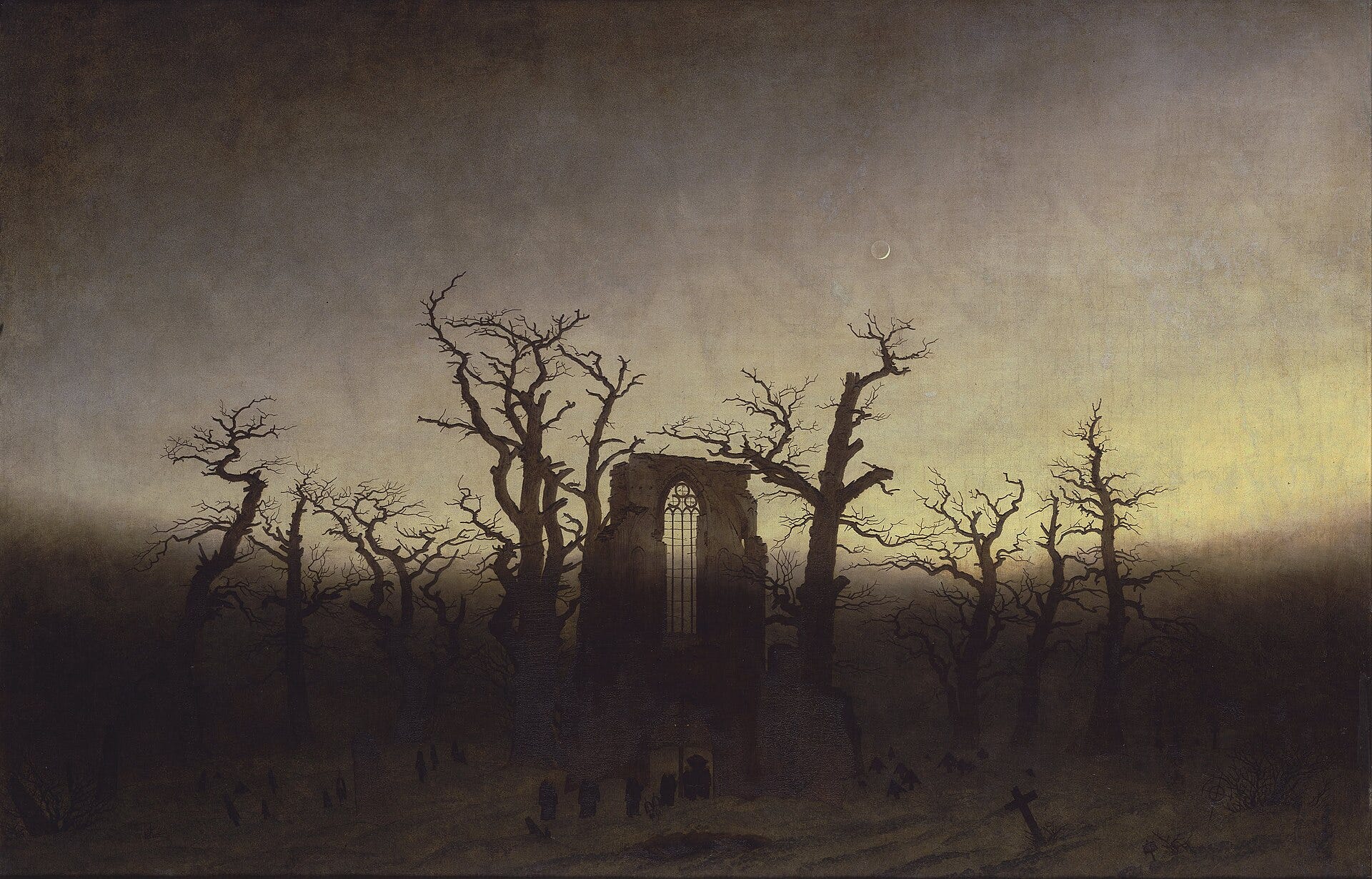
The Abbey in the Oakwood - Caspar David FriedrichAbstract
In this article, I revisit my earlier post Expanding on Max Stirner: The Limits of Ego and its subsequent extension The Nishidan Spook: Authority After the Ego. While Nishida successfully pushes Stirner’s critique one level deeper by dissolving the ego as ground, I argue that Nishida’s philosophy remains incomplete. Building on my previous claim that dissolving the ego does not automatically dissolve grounding itself, this article pushes the critique to its final level by examining both Stirner and Nishida through the work of Andrea Emo. Here, I introduce the concept of the Emonian Spook, a final-stage critique that reveals how even exposure, negation, and philosophical insight can themselves become illusory. The Emonian Spook marks the terminal limit of philosophical dissection.
Nishida and Stirner Revisited
Below is a summary of Max Stirner’s core ideas, followed by their revision through Nishida. These are summaries, not direct quotations.
The Ego (The Unique One): The self, defined by individual will and desire, free from external authorities or ideals.
The Spook: An external idea or ideal (e.g., morality, religion, the state) that has power over the individual by being perceived as a higher truth. Once you recognize it as a spook, it no longer controls you, as you see it for what it is, just an idea, not an objective authority.
At this level, Stirner’s critique is effective. He shows how domination operates through concealment and how recognition restores self-ownership. Seeing the spook is useful to the ego because it liberates the ego from obedience.
However, Stirner’s demolition implicitly assumes that the ego itself can occupy a privileged position outside illusion. Once all external authorities are dissolved, the ego remains standing as the final reference point. The critique stops where self-ownership is affirmed. Nishida intervenes.
Nishida’s Correction
For Nishida, experience is primary. Before there is a subject who thinks or an object that is thought about, there is the occurring of experience itself. Seeing, hearing, acting, and feeling arise prior to ownership. The ego appears later as a differentiation within this field, real, functional, and operative, but not foundational.
From this perspective, Stirner’s ego is not false, but misplaced. The error is not ego-action, but ego-as-ground. When the ego is treated as the center, a derivative distinction is mistaken for the origin. Reality becomes reorganized around ownership, installing a hidden metaphysics even when all explicit metaphysical claims have been rejected.
Nishida extends this critique beyond the ego. Any articulation, subject, reason, history, Being, even Nothingness, becomes illusory the moment it claims to be reality in totality. Reality differentiates and negates itself continuously; it cannot be finished, owned, or closed without distortion.
The Nishidan Spook
To clarify: the term Nishidan Spook is my own extension of Stirner’s concept, not Nishida’s language.
Nishidan Spook: Any abstraction that does not merely dominate thought (as in Stirner), but reorganizes experience itself by masquerading as the ground of being.
Where the Stirnerian Spook preserves the ego by demanding obedience, the Nishidan Spook preserves Being by claiming totality. At this stage, domination has been replaced by grounding, and the critique appears complete. But a deeper illusion remains.
For a more detailed discussion of Stirner and Nishida, please see my earlier post, The Nishidan Spook: Authority After the Ego.

Andrea Emo and the Authority of Thought
Andrea Emo begins where Nishida stops. For Emo, the fundamental illusion is not the ego, nor Being, nor Nothingness, but the belief that philosophical exposure itself escapes illusion. The moment thought claims to reveal, negate, or dissolve reality, it installs itself as authoritative.
Negation does not uncover a deeper structure. Insight does not occupy a privileged position. Even the recognition that “nothing can be grounded” becomes an assertion the moment it is trusted.
Where Nishida treats negation as a dynamic of reality, Emo treats negation as already compromised. The act of revealing is never outside the illusion it claims to expose. From an Emonian perspective, both Stirner and Nishida remain bound by a deeper illusion.
Stirner Possessed
Stirner assumes that seeing the spook is useful, that exposure liberates. But this already presumes that recognition occupies a position of escape. The moment demystification is trusted as freedom, it becomes authoritative. Stirner’s final faith is not merely in the ego, but in exposure as exit.
Nishida possessed
Nishida dissolves the ego as ground, but preserves a deeper confidence: that self-negation can be meaningfully described without reinstating authority. Absolute nothingness, though non-substantial, still functions as an explanatory field. Insight remains genuine, even if non-final.
From Emo’s standpoint, this is already too much. Nishida replaces ego-grounding with negation-grounding, preserving philosophy’s right to speak about what remains. Both thinkers differ in depth, but share the same structural error: they assume that exposure itself is not implicated.
Emonian Spook
Emonian Spook: The belief that exposure itself escapes illusion, that by revealing contradiction, negation, or groundlessness, thought has achieved a privileged position outside what it criticizes.
The Emonian Spook convinces the thinker that nothing remains, while granting authority to that conclusion.
Stirner asks: What rules over me?
Nishida asks: What claims to be the ground at all?
Emo asks: What allows this questioning itself to claim authority?
Example
Person A says:
Recognizing that there is no final truth frees us from illusion
This is an Emonian Spook because it treats recognition itself as an escape, granting authority to the insight that supposedly dissolves all authority.
Person B says:
This thought occurs and has no right to last
This is not an Emonian Spook because it makes no claim to privilege, freedom, or finality, and does not trust itself to stand outside what it describes.
Why the Emonian Spook Is the Last Layer
Stirner claims the ego should rule as a hidden ‘ought‘. Nishida shows that experience occurs prior to the ego, so treating the ego as ruler is already a misidentification. Emo goes further and shows that even diagnosing misidentification presumes a position of escape, so the very act of questioning control reinstates it.
The Emonian Spook cannot be exposed without reappearing. To name it is already to trust naming. To reject it is to trust rejection. To accept it is to stabilize it. There is no deeper abstraction to unmask because abstraction itself has been unmasked. There is no quieter authority to reveal because authority now operates as the absence of authority. Below this point, philosophy does not deepen. It collapses.
If this work matters to you, your support is what allows it to continue